
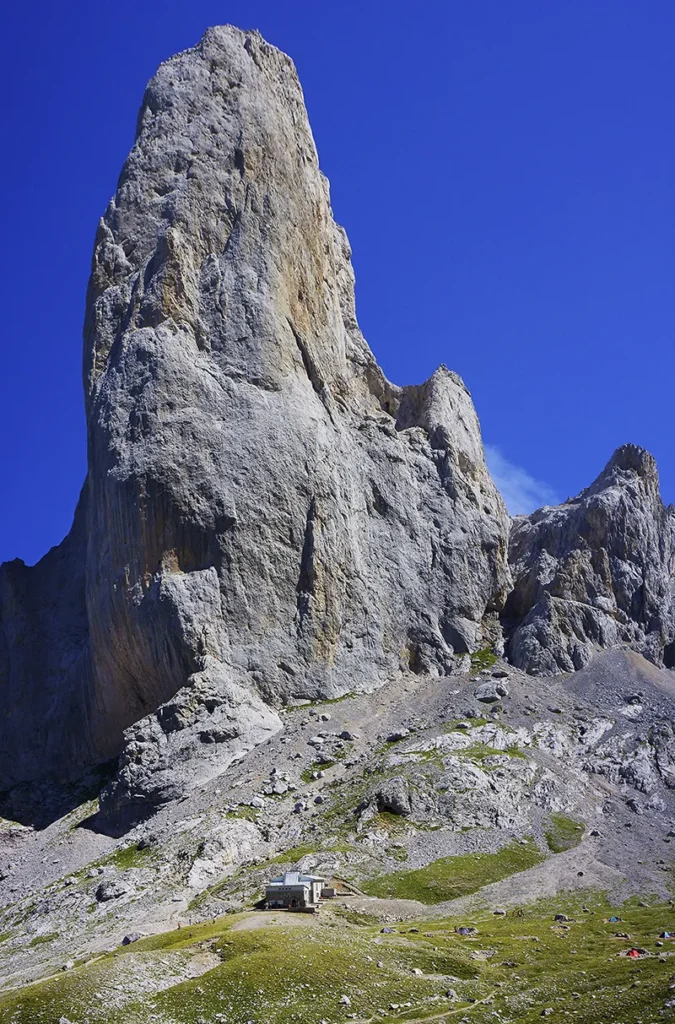
Few mountains in Spain are as recognisable as the Naranjo de Bulnes, also known by its Asturian name, Picu Urriellu. This 2,519-metre limestone tower, at the heart of the Central or Urrieles Massif, inside the Picos de Europa National Park, has been a symbol of Spanish mountaineering for over a century.
Where the name comes from
The origin of the name has been debated for decades. The most repeated explanation points to colour: the limestone of its west face takes on orange tones in the evening light, a sight nobody who has seen it forgets. Another hypothesis links it to Asturian words such as narancu, used for crags and high ground.
Among climbers and locally, the Asturian name is preferred: Picu Urriellu, which is what the shepherds of these valleys have always called it. Both names coexist, and neither is wrong.
1904: the first ascent
The Naranjo's story as an icon begins on 5 August 1904, when Pedro Pidal, Marqués de Villaviciosa de Asturias, and the local shepherd and guide Gregorio Pérez, known as "El Cainejo", reached the summit for the first time.
It was an ascent from another era: no modern technical gear, hemp ropes, and El Cainejo leading barefoot on the most delicate sections to get a better grip on the rock. They came down after dark, following a forced bivouac. That same Pedro Pidal would years later drive the declaration of Spain's first national park, in 1918: the Naranjo and the protection of the Picos share a leading character.
The climbers' mountain
The west face of the Urriellu, some 550 metres of vertical wall, became over time the great stage of Spanish climbing. Every generation has left its mark there.
The most celebrated line is the Rabadá-Navarro, opened in 1962 by Alberto Rabadá and Ernesto Navarro, from Zaragoza, after several attempts and days on the wall. It was a step up for Spanish alpinism at the time and remains a benchmark route. Both climbers would die the following year on the north face of the Eiger, and their names stayed bound to this wall for good.
Today the Urriellu holds dozens of itineraries at every grade, and in the good months it is common to watch roped parties working the face from the meadow below, a spectacle in itself even if you do not climb.
Seeing it up close without climbing
You do not need to be a climber to experience the Naranjo. The usual way to admire it is to walk up to the Vega de Urriellu, the meadow that opens right at its foot, where the Delgado Úbeda refuge stands.
You go up from Bulnes or from Sotres, on a long route with considerable elevation gain, but one that requires no climbing technique: just good fitness, proper footwear and respect for the mountain. Allow a full day if you are going up and back in one go, and consider spending the night at the refuge if you want to see the wall at sunrise, which is when it looks its best.
If you would rather have a far easier option, the Camarmeña viewpoint, above Poncebos, gives you a head-on view of the Naranjo after a short walk from the village. It is the quickest way to put a face to the mountain, and ideal at sunset.
Note that the refuge works by prior booking and that its season varies, so it is worth checking availability well in advance, especially in summer.
Bulnes, the village with no road
The classic approach to the Urriellu goes through Bulnes, one of the most singular places in the Picos: a village that to this day no road reaches.
For centuries the only way in and out was the Canal del Texu, a cobbled path climbing up from Poncebos along the gorge, with a considerable height gain and a little over an hour of ascent at a good pace. Everything came through there: people, livestock and supplies.
In 2001 a funicular railway opened, crossing the mountain through a tunnel more than two kilometres long and covering the height difference in a few minutes. It changed village life and sent visitor numbers soaring. Both options are still open: the path, for anyone who wants to earn their arrival; the funicular, for those short on time or travelling with children.
At the top, Bulnes is split into two hamlets: La Villa, the larger one, and El Castillo, slightly higher and with the best views. Stone houses, a handful of residents and a silence you can feel.
From El Ardinal
Reaching the Vega de Urriellu and seeing the Naranjo rise right in front of you, especially at sunrise or sunset, is one of those experiences that stays with you. From El Ardinal, in Arenas de Cabrales, Poncebos is 6 km away, which makes both the walk up to Bulnes and the approach to the Urriellu easy plans to organise.
If you would prefer a gentler first encounter, the Cares Route runs through the gorge separating this massif from the western one with hardly any elevation gain, and shares the same starting point as the Naranjo. Here are the rest of the hiking routes from Cabrales.
Sources: the municipality (Cabrales Town Council, in Spanish), Poncebos–Bulnes route (Cabrales Town Council, in Spanish), Pandébano–Picu Urriellu route (Cabrales Town Council, in Spanish).